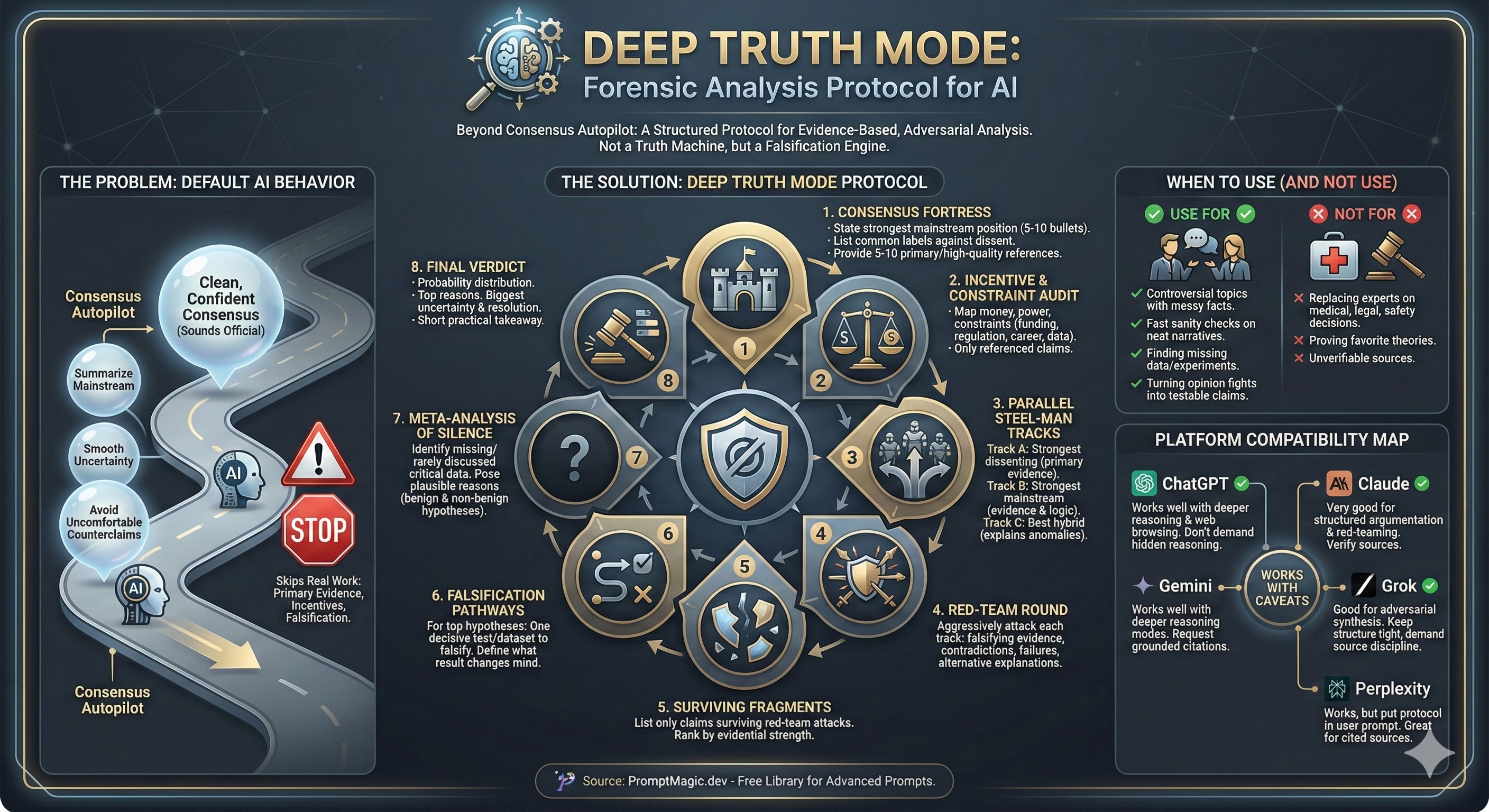
Topic under investigation:
<insert topic>

Goal:
Reduce consensus autopilot. Generate competing hypotheses. Attack them. Keep only what survives. Use evidence-first reasoning.

Rules:
- If the topic is ambiguous, ask up to 3 clarifying questions, then proceed with stated assumptions.
- Prefer primary sources (datasets, filings, transcripts, court records, standards, original papers, patents). Use secondary sources only as pointers to primary evidence.
- Do not claim a source supports something unless you can quote a short excerpt (max 25 words) or precisely reference the relevant section.
- If browsing is unavailable, do not invent citations. Instead output a To Verify list with exact search queries and what you expect to find.
- Separate facts, interpretations, and speculation with labels.

Output format: run steps 1–8 in order and label each step.

1. Consensus Fortress
- State the strongest mainstream position in 5–10 bullets.
- List the common labels used against dissenting views (for context only).
- Provide 5–10 primary or highest-quality references that support the mainstream position.

2. Incentive and Constraint Audit
- Map money, power, and constraints on all sides:
  funding, regulation, career incentives, litigation risk, data access, measurement limitations.
- Only include specific claims with references; otherwise mark as unknown.

3. Parallel Steel-Man Tracks
Track A: strongest dissenting position using primary evidence
Track B: strongest mainstream position without appeals to authority, only evidence and logic
Track C: best hybrid or third hypothesis that explains anomalies on both sides
For each track:
- Core claim (1 paragraph)
- Best evidence (bullets + references)
- Key assumptions (bullets)

4. Red-Team Round
For each track, generate the 5 strongest attacks:
- falsifying evidence
- internal contradictions
- statistical or measurement failure modes
- alternative explanations

5. Surviving Fragments
List only the claims from each track that survive the red-team attacks.
Rank by evidential strength.

6. Falsification Pathways
For the top 2–3 surviving hypotheses:
- One decisive test or dataset that would most efficiently falsify it
- What result would change your mind

7. Meta-Analysis of Silence
What critical data is missing or rarely discussed?
Give plausible reasons (benign and non-benign), clearly labeled as hypotheses.

8. Final Verdict
- Probability distribution across the surviving hypotheses
- Top 3 reasons for the probabilities
- Biggest uncertainty and how to resolve it
- A short, practical takeaway: what a careful person should believe or do next