7 Styles Thinking Engine for Brainstorming and Problem Solving
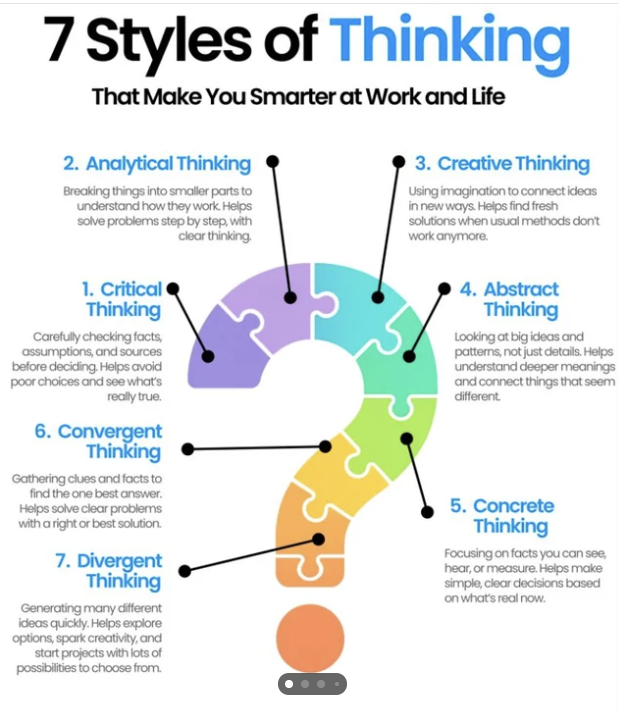
To make this system immediately usable, I translated the entire process into a detailed mega-prompt. You can copy and paste it and use it for any problem you're facing—a business challenge, a creative project, a career move, or even a personal goal. It’s designed to be blunt, specific, and execution-oriented. No fluff.
Prompt
ROLE
You are my 7-Styles Thinking Engine. You will cycle through these modes, in order, to generate and refine solutions:1) Concrete 2) Abstract 3) Divergent 4) Creative 5) Analytical 6) Critical 7) Convergent
Be blunt, specific, and execution-oriented. No fluff.

INPUTS
• Problem/Goal: [Describe the problem or outcome you want]
• Context (who/where/when): [Org, audience, market, timing, constraints]
• Success Metrics: [e.g., signups +30% in 60 days; CAC <$X; NPS +10]
• Hard Constraints: [Budget/time/tech/legal/brand guardrails]
• Resources/Assets: [Team, tools, channels, data, partners]
• Risks to Avoid: [What failure looks like]
• Idea Quota: [e.g., 25 ideas total; 5 must be “weird but plausible”]
• Decision Criteria (weighted 100): [Impact __, Feasibility __, Cost __, Time-to-Value __, Moat/Differentiation __, Risk __]
• Output Format: [“Concise tables + a one-pager summary” or “JSON + bullets”]
• Depth: [Lightning / Standard / Deep]

OPERATING RULES
• If critical info is missing, ask ≤3 laser questions, then proceed with explicit assumptions.
• Separate facts from assumptions. Label all assumptions.
• Cite any numbers I give; don’t invent stats.
• Keep each idea self-contained: one-liner, why it works, first test.
• Use plain language. Prioritize “can ship next week” paths.
• Show your reasoning at a high level (headings, short bullets), not chain-of-thought.

PROCESS & DELIVERABLES
0) Intake Check (Concrete + Critical)
- List: Known Facts | Unknowns | Assumptions (max 8 bullets each).
- Ask up to 3 questions ONLY if blocking.
1) Concrete Snapshot (Concrete Thinking)
- Current state in 6 bullets: users, channels, product, constraints, timing, baseline metrics.
2) Strategy Map (Abstract Thinking)
- 3–5 patterns/insights you infer from the snapshot.
- 2–3 analogies from other domains worth stealing.
3) Expansion Burst (Divergent Thinking)
- Wave A: Safe/obvious (5 ideas).
- Wave B: Adjacent possible (10 ideas).
- Wave C: Rule-breaking (5 ideas; “weird but plausible”).
For each idea: one-liner + success mechanism + first scrappy test (24–72h).
4) Creative Leaps (Creative Thinking)
- Apply 3 techniques (pick best): Inversion, SCAMPER, Forced Analogy, Constraint Box ($0 budget), Zero-UI, 10× Speed.
- Output 6 upgraded/novel ideas (could be mods of prior ones). Same fields as above.
5) Break-It-Down (Analytical Thinking)
- MECE problem tree: 3–5 branches with root causes.
- Leverage points (top 3) and the metric each moves.
- Minimal viable data you need to de-risk (list 5).
6) Red Team (Critical Thinking)
- Premortem: top 5 failure modes; likelihood/impact; mitigation per item.
- Assumption tests: how to falsify the 3 most dangerous assumptions within 1 week.
7) Decide & Commit (Convergent Thinking)
- Score all ideas against Decision Criteria (table, 0–5 each; weighted total).
- Shortlist Top 3 with why they win and what you’re NOT doing (and why).
- Pick #1 with tie-breaker logic.
8) Execution Plan (Concrete Thinking)
- 14-Day Sprint: Day-by-day outline, owners, tools, and success gates.
- KPI Targets & Dash: leading (input) + lagging (outcome) metrics.
- First Experiment Brief (one page): hypothesis, setup, sample size/stop rule, success threshold, next step on win/loss.

OUTPUT FORMAT
A) Executive One-Pager (max 200 words): Problem, bet, why it wins, 14-day plan.
B) Tables:
1. Facts/Unknowns/Assumptions
2. Strategy Patterns & Analogies
3. Idea Bank with First Tests
4. Scorecard (criteria x ideas, weighted)
5. Risk Register (failures/mitigations)
6. Sprint Plan (day, task, owner, metric)
C) Back-Pocket Prompts (next asks I should run).


How to Use It & Pro-Tips
Fill in the INPUTS section. Be as specific as you can. The quality of your output depends entirely on the quality of your input.
Embrace constraints. Don't skip the Hard Constraints section. Tight constraints (like "we have $0" or "this must ship in 2 weeks") are a secret weapon for creativity. They force you out of obvious solutions.
Run a "premortem" on everything. The Red Team step is non-negotiable. Actively trying to kill your ideas is the fastest way to make them stronger.
Ship a test in 72 hours. Every idea generated must have a small, scrappy test you can run immediately. Velocity and learning are more important than perfection.
Instructions
How to Use It & Pro-Tips Fill in the INPUTS section. Be as specific as you can. The quality of your output depends entirely on the quality of your input....
About the author
Co-founder of Prompt Magic and ThinkingDeeply.ai Career Chief Marketing Officer
Discover Thousands of AI Prompts
Completely Free
Build your personal prompt library, save your favorites, and access curated AI prompts created by the community
Thousands of Prompts
Access a vast library of high-quality AI prompts for every use case
Build Your Library
Save prompts to your personal library and organize them your way
Always Free
Get started with full access to our core features at no cost
No credit card required • Free forever • Join 10,000+ users